DEVILS LAKE, N.D. - Check-off funds paid by North Dakota corn producers are being used for a wide variety…
If you don't see the information you're looking for below, please contact us.
• In a landmark study completed in 2008, the U.S. Department of Energy’s Oak Ridge National Laboratory found no significant changes in the operation of vehicles when E15 and E20 were compared to conventional gasoline.
• In a 2008 report on E20 prepared by the Rochester Institute of Technology and submitted to Congress, researchers found no issues on a fleet of 10 aging cars used in the city’s vehicle fleet. Those “legacy” vehicles were driven nearly 75,000 miles apiece using E20 without any issue that could be attributed to the fuel.
• As gas prices continue to rise, mid-range ethanol blends are the cost-efficient solution.
Ethanol is historically cheaper than conventional gasoline, meaning the higher the blend, the cheaper the fuel. Research has shown mid-level blends increase mileage, thereby reducing out-of-pocket fuel costs.
• Ethanol blends offer an environmentally conscious solution.
All levels of ethanol-enriched fuel emit less carbon monoxide and other greenhouse emissions than conventional gasoline and meet EPA requirements. However, the higher levels of ethanol available through alternative blends offer more impressive results. Research has confirmed that using the ideal ethanol blend for a given vehicle dramatically reduces emissions.
• Increased usage of alternative blends ultimately decreases the demand for foreign oil.
Reducing America’s dependence on foreign oil offers America the opportunity to boost our own economy and the growth and development of the ethanol industry on our own soil. Asserting our energy independence and taking control of our fuel supply will strengthen our national and economic security.
Ethanol is a clean-burning, American-made alternative fuel produced from renewable resources, such as the starch in field corn. The only commercially-viable alternative to gasoline derived from foreign oil is American ethanol. The ethanol we make here in America is already replacing hundreds of thousands of barrels of foreign oil every day, and we have the capacity to replace more.
• Grain ethanol is at least 59 percent cleaner-burning than conventional gasoline.
• Ethanol is already added to most fuel as an oxygenate to reduce tailpipe emissions and as an octane-enhancer; pure ethanol is at least 113 octane.
• Many states require the maximum-allowable blend of ethanol under federal law so those states can meet standards set by the Clean Air Act. This is because ethanol cuts tailpipe emissions.
Higher blends include any ethanol blend above 10 percent (E10). The most common are E20, E30, E40, E50 and E85. The “E” in the designation simply indicates that the fuel contains ethanol — and the number associated with it is the percentage of ethanol in that blend. For example, E20 is 20 percent ethanol, 80 percent gasoline. E85, the most common higher blend, is 85 percent ethanol and 15 percent gasoline.
E85 is the term for motor fuel blends of 85 percent ethanol and just 15 percent gasoline. E85 is an alternative fuel as defined by the U.S. Department of Energy. Besides its superior performance characteristics, ethanol burns cleaner than gasoline; it is a completely renewable, domestic, environmentally friendly fuel that enhances the nation's economy and energy independence. Today, the U. S. imports more than half of its oil, and overall consumption continues to increase. By supporting ethanol production and use, U.S. drivers can help reverse that trend. 85% ethanol can reduce pollution. Government tests have shown that E85 vehicles reduce harmful hydrocarbon and benzene emissions when compared to vehicles running on gasoline. E85 can also reduce carbon dioxide (CO2), a harmful greenhouse gas and a major contributor to global warming. Although CO2 is released during ethanol production and combustion, it is recaptured as a nutrient to the crops that are used in its production. Unlike fossil fuel combustion, which unlocks carbon that has been stored for millions of years, use of ethanol results in low increases to the carbon cycle. Ethanol also degrades quickly in water and, therefore, poses much less risk to the environment than an oil or gasoline spill.
• E85 has an octane of approximately 105.
• E85, in most cases, sells for less than the price of unleaded gasoline.
• Ethanol reduces the incidence of greenhouse gas emissions.
• Ethanol is domestically produced and promotes energy independence.
• Ethanol production increases the value of feed grains grown by farmers.
• Ethanol is biodegradable and does not contaminate water.
• Ethanol can be produced from a number of different feedstocks including paper and agricultural waste.
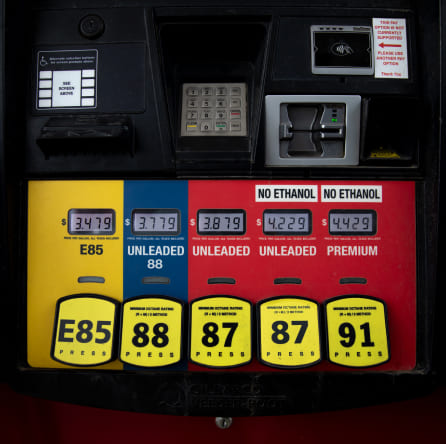
A blender pump draws fuel from two underground tanks and blends the fuels as dictated by the consumer’s choice of blend. One tank can contain either E10 (10 percent ethanol) or regular unleaded gasoline. The other tank can contain either E85 (85 % ethanol) or denatured ethanol, (98% ethanol). As the consumer chooses the blend on the dispenser face, the blender pump automatically draws fuel from each tank as appropriate in order to deliver the preferred blend.
Blender pumps are a simple but effective way of putting the power to choose back in the hands of the consumer. In the U.S., blender pumps offer a range of ethanol blended fuels for FFV drivers, meaning an FFV driver could choose E15 – or E20, E30, E40 or E50, all the way up to E85.
Alternative ethanol blends are created at the blender pump by merging appropriate percentages of E85 and unleaded gasoline. For example, an E20 blend uses 24 percent E85 (containing 85% ethanol) and 76 percent unleaded fuel. The process is invisible at the pump; all the consumer does is push the key for their desired blend, just as they do today based on octane levels and price.
A blender pump, or flex fuel pump, gives an FFV owner a great deal of flexibility and options. Just because you drive an FFV does not mean you have to fill up with E85 all the time. A blender pump gives FFV owners the opportunity to fill up with various ethanol blends based on pricing and their vehicle’s performance.
Since the blender pump includes E10 as a standard choice for consumers, you are also providing a fuel that virtually every consumer can use. Additionally, when you have a blender pump at your station, you are showing consumers that you have their best interests in mind.
For the retailer, this technology also allows the cost of the dispenser to be spread across all blends and all customers.
Incentives to Sell Mid-Level Blends of Ethanol
After the hike in oil prices during the summer of 2008, consumers are looking for more choices at the pump. In October 2008, Growth Energy funded an Attitudes, Awareness and Usage (AA & U) survey and discovered the following:
- 45 percent of Americans are seeking out alternatives, especially ethanol-blended fuels
- 26 percent of those surveyed purchase ethanol because it helps the environment
- 19 percent purchased ethanol due to the of cost savings
- After reading more about ethanol’s benefits, an additional 27 percent would purchase ethanol
Meeting the Renewable Fuels Standard. The ethanol industry is currently being held back by the regulatory cap that is being placed on the amount of ethanol that can be blended into gasoline. In order to overcome this cap, or “blend wall,” and meet the Renewable Fuel Standards of 36 billion gallons of ethanol, there needs to be more ethanol blended into our current energy supplies. If the maximum amount of ethanol blended into gasoline remains at E10 (10 percent ethanol, 90 percent gasoline), it equals only 14 billion gallons, which is short of the required 36 billion gallons necessary to meet the mandate. Improving the infrastructure and amount of ethanol sold is necessary for our nation to reduce our dependence on foreign oil, provide a cleaner and greener energy source and improve our country’s economy.
The technology that allows a blender pump to work is resident in the pump mechanism itself, so you simply need to connect the pump to two underground storage tanks, something you likely have connected to your pump locations currently. You’ll need to clean the tanks as necessary in order to accommodate the two fuels for the blender pump. If you already have E10 or ordinary gasoline in one tank, most likely you can fill the other with E85 or denatured ethanol and be ready to install your blender pump
No. While all major automakers approve the use of E10 (10 percent ethanol) in their vehicles, the Environmental Protection Agency (EPA) only allows the use of higher blends in blender vehicles (FFVs). FFVs have specially designed fuel systems that automatically adjust to run on a wide range of fuel blends — from E85 to E10 to 100 percent ordinary gasoline, and every combination in between. (That’s why they are known as “flex” fuel vehicles.)
A computer in the vehicle automatically adjusts for the amount of ethanol in the gasoline, allowing a driver to fill up with E85 one time, E10 the next, etc. as availability and price dictate. Obviously, this mixing of ethanol blends may result in higher blends of ethanol in the tank at any one time—and the computer system adjusts to compensate accordingly. That’s why blender pumps make sense for FFV owners.
There are more than 8.5 million FFVs on America’s highways today — and the three U.S.-based automakers have committed to manufacture 50 percent of their vehicles as FFVs by 2012. There are more than 2,360 E85 fueling stations across the nation and 277 stations with a blender pump installed — and more are being added every week.
Preliminary studies have actually shown fuel economy gains with mid-level blends such as E20 and E30. E85 does have a fuel economy loss, but is typically priced low enough to offset that loss. (That’s the advantage of owning a FFV. You have more options as fuel prices fluctuate). By the way, most drivers using E10 (the standard 10 percent ethanol blend) see no difference in fuel economy — and some see a gain.
Testing is underway to determine the effectiveness of blends up to E20 in non-FFV vehicles.
Yes. Visit this link to the U.S. Department of Energy's website to learn about incentives available in your state.
Flexible fuel vehicles (those vehicles with engines that operate on E85 gasoline-or any blend thereof) are standard equipment on certain makes and models of automobiles and trucks produced by Ford Motor Company, General Motors, Chrysler, Nissan, Mazda Motors and Toyota.
In these models, the vehicles are available with an E85 flexible fuel engine. Some are also available as gasoline-only powered engines. The ability of these vehicles to operate on both E85 and gasoline are provided by the automakers at no additional cost to the consumer. These vehicles carry the same warranties as those which can only operate on gasoline.
No. In fact, studies and analysis currently underway indicate that a vehicle operating on mid to high blends of ethanol runs both cleaner from the exhaust emission aspect and in regard to the engine operation/performance. While these studies are not yet completed, evidence exists that some maintenance costs may actually be reduced in the long run.
During current model years, Chrysler does require the use of a special motor oil to operate vehicles it produces on E85. Both GM and Ford allow their E85 vehicles to be operated on the same motor oils used in gasoline-only operation and at the same oil change frequency.
No. This has been a common misconception of the ethanol industry, that it takes more energy to make ethanol than is available to the final consumer. Remember, ethanol is produced from plant matter, today dominated by corn, wheat, potatoes, sorgum, etc. Plants grow through the use of energy provided by the sun and are a renewable resources. In the future, ethanol will be produced from waste products or "energy crops." In fact BC International (BCI), is currently constructing an ethanol production plant in Louisiana that will use sugar cane waste to produce ethanol. Additionally, BCI is considering the establishment of ethanol production facilities in California that would use the waste hulls from rice growers and wood waste from the forest industry to produce ethanol. Energy crops such as perennial switch grasses, timothy, and other high-output/low-input crops will be used in the future.
Current research prepared by Argonne National Laboratory (a U.S. Department of Energy Laboratory), indicates a 38% gain in the overall energy input/output equation for the corn-to-ethanol process. That is, if 100 BTUs of energy is used to plant corn, harvest the crop, transport it, etc., 138 BTUs of energy is available in the fuel ethanol. Corn yields and processing technologies have improved significantly over the past 20 years and they continue to do so, making ethanol production less and less energy intensive.
Ethanol and gasoline use a similar amount of water for production – about 3 gallons of water for every gallon. In fact, a 40 million gallon per year ethanol plant uses roughly the same amount of water on a daily basis as an 18-hole golf course.
Gasoline-ethanol blends containing up to 10% volume ethanol may be used in any vehicle. The EPA has recently approved E15 for the use of vehicles for 2001 and newer. The addition of ethanol boosts octane and, because it is an oxygenate, ethanol contributes to a more complete fuel combustion resulting in reduced emissions of carbon monoxide and other ozone-forming emissions. All major auto manufacturers approve the use of up to 10% volume ethanol.
In fact, some manufacturers, such as General Motors, Chrysler, Ford, Nissan, Range Rover, and Suzuki recommend the use of oxygenated fuels and/or reformulated gasoline for their clean burning characteristics. Blends above 10% volume are not approved by the auto manufacturers or the EPA for use in standard gasoline engine vehicles.
The Energy Policy Act of 1992 also recognizes E85 (a blend of 85% ethanol and 15% unleaded gasoline) as an alternative fuel. In order to operate on E85, vehicles need to be compatible with alcohol use. The conversion cost to make FFVs compatible with E85 typically includes upgrades to the fuel system components, the addition of a fuel sensor, and reprogramming the EPOM (computer chip) in the ECM/PCM (electronic control module/power train control module).
No. 100% ethanol can be and is ingested by human beings. The fuel ethanol must be "denatured" with gasoline or a bitter agent to prevent ingestion. Also, ethanol does not contain the harmful carcinogens and toxins found in gasoline.
The National Fire Protection Association is a consortium of fire experts from across a wide range of areas of expertise. NFPA publishes brochures and documents the outline how to fight fires, build fire-resistant buildings, etc.
NFPA Code 30 and 30A establish firefighting techniques for unleaded gasoline. NFPA 30 and 30A also recommend that the same form of fire fighting chemicals and techniques be used on E85 as is used to fight fires fueled with unleaded gasoline. The NFPA does not require different fire fighting for ethanol in comparison to gasoline.
For more information, go to http://www.fireworld.com/ifw_articles/e95_08_07.php
Although your vehicle was not manufactured to run on E85, no problems should occur if you mistakenly fuel once with the alternative fuel. The largest difference between an E85 powered vehicle and a gasoline powered vehicle is that their computer modules are meant to read different amounts of oxygen within the fuel. E85 contains a higher amount of oxygen than gasoline and E85 compatible vehicles are made to read that higher amount. When a higher amount of oxygen is read by a gasoline powered vehicle, your "check engine light" may appear. A number of other parts on the FFV's fuel delivery system are modified to be ethanol-compatible. The fuel tank, fuel lines, fuel injectors, computer system and anti-siphon device have been modified slightly. Alcohol fuels can be more corrosive than gasoline. Therefore; fuel system parts have been upgraded to be ethanol-compatible.
Ultimately it is a drivers choice, but we do need to be firm in recommending that only FFVs use E85 and to state that we are not responsible for damages.
Go to http://ethanolretailer.com/flexible-fuel-vehicles/ to see if your vehicle is E85 compatible, and to see a full list of flex fuel vehicles being sold today.
Unfortunately, there is no simple answer. In the strictest sense, yes, a vehicle that was designed to operate on unleaded gasoline only could be converted to operate on E85. Realistically, the conversion is extremely difficult. Below explains the reasoning. Be aware that Flex Fuel U.S. has obtained the only U.S. Environmental Protection Agency (EPA) approval for an E85 conversion kit. The Flex-Box Smart Kit™ is approved for for Dodge vehicles such as the Dodge Charger, Dodge Magnum, Chrysler 300 2wd and AWD 5.7L Hemi as well as vehicles from Ford that include Crown Victoria, LIncoln Town Car, Mustang, F150, Navigator and Expedition.
During the 1980’s and early 1990’s, many small companies were formed that were altering gasoline-powered vehicles to operate on other forms of fuels such as propane, compressed natural gas, 85 percent ethanol and 85 percent methanol. The marketing program of these conversion companies was based on the premise that it was cheaper to operate a vehicle on alternative fuels. However, the vehicles being converted were engineered, designed and built to operate on unleaded only. Shortly after the emergence of the “conversion firms” the EPA determined that when converted from gasoline to another form of fuel, the exhaust emissions from these converted vehicles were often much “dirtier” than prior to conversion. See explanation regarding EPA Memo 1A. The use of alternative fuels in the transportation sector has been built around the objectives of using cleaner, non-gasoline based components.
Based on the federal authority provided to the EPA through the Clean Air Act Amendments of 1990, the EPA implemented regulations that required the exhaust emissions from vehicles converted to run on alternative fuels be “as clean as the exhaust emissions of the original gasoline equipment.” That is, if Ford Motor Company manufactured a vehicle to meet federal emissions standards on gasoline, a company converting that vehicle to operate on propane, must be able to certify that the emissions from the converted vehicle was as good as the original. A process to certify such after-market equipment was initiated and ultimately, few if any conversion kits were able to qualify.
Today, 99.9 percent of the vehicles that are capable of operating on alternative transportation fuels are produced by the original equipment manufacturers such as Ford, General Motors, and DaimlerChrysler. Engineers from these companies are able to design and build vehicles that meet the EPA exhaust emission standards. These companies also are required to warranty the exhaust emissions from these vehicles for 10 years or 100,000 miles, something very few conversion companies are able to accomplish. However, as you will read below, that might be changing.
E85 has the highest oxygen content of any transportation fuel available today, making it burn cleaner than gasoline. Fewer exhaust emissions result in reduced production of smog and a decline in respiratory illness associated with poor air quality. E85 also reduces greenhouse gas emissions such as carbon dioxide, the main contributor to global warming, as much as 39 to 46 percent compared to gasoline.
Since E85’s main ingredient is ethanol, which is non-toxic, water soluble and biodegradable, E85 is simply a better fuel for the world around us.
As was the case in the early 1970s, the American motorist has recently experienced a new run-up in the price of motor gasoline. The oil shortages of 1973-74 were the result of an embargo; the oil charges of 1991 were the result of the Gulf War; while the price spike of early 2000 was the result of planned supply reductions which increased the price of crude oil from $11 to $32 per barrel. This increased price of imported oil has also been the primary cause of the U.S. balance of trade deficit setting record after record, month after month.
The United States imports over 53 percent of its total energy and uses more energy than any other nation in the world. The use of alternative fuels, including propane, natural gas, methanol, electricity, and ethanol, will all contribute to a reduction in the amount of crude oil used in vehicle operations.
Not only does using E85 help reduce American dependence on foreign oil, but because Ethanol is produced from crops grown in the U.S., it can also help stabilize commodity prices. And because E85 is a viable, home-grown alternative to gasoline, E85 provides competition, which is good for consumers.
In the near future, a wide range of waste products will be used to produce ethanol, further developing our national energy independence. Ethanol production is estimated to increase net farm income more than $4.5 billion. It boosts employment by 200,000 jobs and improves the balance of trade by over $2 billion. The pricing for E85 is comparable to traditional gasoline.
Energy independence was forefront in the minds of Americans during the 1970s when gas prices soared and lines formed at every gas station. Consumers responded with energy saving practices and smaller cars…and then quickly forgot. We forgot that using less oil is only one part of the solution. Ultimately we need to be more energy independent.
Twenty years later, prices are again soaring and consumers are demanding answers. Well, this time E85 offers an alternative. E85 is a home-grown alternative fuel produced from crops and waste products. It is environmentally good for us—think of it…turning waste into fuel! It is economically good for us—stabilizing commodity prices and increasing U.S. jobs. It is good for our transportation needs—with more than 750,000 flexible fuel vehicles on the market this year.